




Janis Goodlet (bass, 1981-2) interview
6 May 2026
 When they formed in the autumn of 1981, Strawberry Switchblade were a four-piece indie guitar band:
- Rose McDowall – vocals, guitar
- Jill Bryson – guitar, backing vocals
- Janis Goodlet – bass, backing vocals
- Carole McGowan – drums
In November 1981 they recorded the three-song demo of Trees and Flowers, Spanish Song and Go Away. A month later, in the week before Christmas, they performed their first gig.
There were at least five other gigs before the rhythm section, Janis and Carole, left in the summer of 1982, about nine months after the band was formed.
35 years later, in 2017, the demo was released as an EP, and its version of Trees and Flowers has become the band’s most popular track.
Carole McGowan died before the release of the demo, and the EP was dedicated to her memory.
Janis Goodlet generously shared her memories of the early days of the band.
Forming the band, getting the songs

Janis Goodlet playing bass in Strawberry Switchblade
Q: What’s your musical background?
I played piano from when I was about seven, so I knew music. I was in a band called Boys At Sea with Graham, I sang and played keyboards.
Q: Was that before Strawberry Switchblade?
Yeah, quite a while before. With Boys At Sea, I really liked the music, I really liked where we were going. I just thought I’d love to be in a girl band. It would be really good to meet girls and learn instruments together from the beginning.
One of the guys who was playing with Boys At Sea at the time, Tommy Udo was his pen name as a journalist [including a review of Strawberry Switchblade for Sounds when Janis was in the band]. His name’s Alan McLaughlin, I knew him as Alan, but most people knew him as Tommy Udo.
He said he knew Rose McDowall, who was in The Poems at the time, and that she was talking about wanting to start a girl band.
I had already met Rose, we ended up meeting up again and she said that she and Jill were thinking about starting the band, and Jill knew Carole who played drums.
By this time, I’d bought a bass because I always wanted to learn a second instrument, and I thought well, I know piano, so I should be able to pick that up. I was playing along to people like The Beat where it seemed quite repetitive and fast. I still don’t think I could play bass that fast, lol. I now know I like more melodic stuff for the bass but it was good to play along with records and practice.
I had never met Carole before. I’d seen Jill at art school dances, but I didn’t know her. We all went to someone’s house and we kind of started playing, I think they wanted to know if I could play! It went well and we all got on, so we decided to do it with the four of us.
Q: When exactly was that?
It was 1981. The weather was quite nice, so it was either spring or autumn.
Q: The timeline seems to be that Strawberry Switchblade were formed somewhere in the autumn of 1981. The first photo of the band was taken at the Botanic Gardens in the snow in November or December. The demo that became the EP was recorded on 22 November 1981, and the first gig was at the Spaghetti Factory a few days before Christmas.
At the far end of your time with the band, there was a gig together in the middle of June 1982 at The Venue in Glasgow, but you and Carole had left by the time of an NME interview six weeks later, on 7 August 1982. So the quartet of Strawberry Switchblade lasted about nine months.
I would have said I was there longer, but maybe not.
Q: I’m really sure that it was only nine months or so. It’s understandable that it seems longer in retrospect though. You were still really young, a time of your life when you’re still coming into the world, there’s so much to express and you’re really trying to make a mark. Your creativity and social life are pretty much your entire life.

Janis Goodlet and Graham Thomson in Boys At Sea
Yeah. And a lot of it went really quickly because I’d been playing with Boys At Sea. We were playing gigs in Glasgow, what was happening was happening quite quickly.
We got that first Strawberry Switchblade gig in the Spaghetti Factory, which was a trendy restaurant, and it was snowing and almost nobody came! The people who did come were our friends.
We practised in the Hellfire Club and I remember thinking, we don’t really have a lot of songs for this. But the songs were coming because Jill had written lyrics and I think she’d written guitar parts, so had Rose. So we just went along with that. I think we only played about five songs in the Spaghetti Factory!
Q: Even six months later in June 1982 where there’s the gig at the Venue, you’d got nine songs and had to repeat one of them for the encore because there weren’t actually any more songs to play.
All bands seemed to do that at the time. We all had about the same amount of songs and we all kind of knew each other, so it was a done thing – let’s just play the most popular one again!
Q: Do you do you remember the first Strawberry Switchblade rehearsal?
I remember the first day that we met. We weren’t in a rehearsal studio, we were just in somebody’s house. I can remember the area it was in, but I don’t know whose house it was. It could have been Jill’s house.
I don’t think there was even a drum kit there, so Carole couldn’t have been playing. I don’t know if she just played percussion or something, but I remember thinking, I like the way Jill plays guitar, I like Rose anyway and I like her voice. And they liked me, and I liked Carole. So we all got on.
I don’t remember what we played or what we did, but I just remember us thinking after that, yes, we get on, we should play together.
I remember some rehearsals and I remember later on as well, we would start thinking, oh, we need to get more songs, although by that time we had quite a few. We would start just messing about and being ridiculous with lyrics and stuff that we knew we couldn’t get up and sing in front of people. I think the longer it was going on, the more serious we got about it. We always had good rehearsals.
Q: Did you write at all?
I don’t write lyrics. I wrote the bass lines and I like to arrange music.
I don’t know who did the most between Jill and Rose. I’m not sure. Carole was playing the drums, she didn’t write any lyrics.
It was all going well, but I feel like we all had different music tastes. That can still work though. You never know what music is going to turn out like.
Q: Did did you write with Boys At Sea?
No, Graham mostly did that. I came up with melody lines and I was kind of arranging stuff, but he wrote the lyrics and he played guitar. At that time, it seemed to be the person who played guitar would come up with chords, and then we would all go from there.
I always came up with the melody, but I wasn’t writing the lyrics. Graham had lyrics, gave them to me, played guitar chords, and I came up with melody. And then everybody came in from there.
But in Strawberry Switchblade, Jill and Rose, well especially Rose, had the melody as she was singing.
Q: Your melodic sense is really clear in your basslines. You’re easily the best musician on that Strawberry Switchblade demo.
Seriously? Thank you.
Q: Yes! There’s real talent there, the songwriting is really intriguing, and the vocals already have the magic, but outside of the bass the musicianship sounds like what it is, people in their teens who are still learning their instruments.
And that’s not a bad thing. It gives it the authenticity, it makes you know this is heartfelt. This is not in it for the money or trying to show off. It’s a big part of what makes the listener trusts that recording, it’s people making it for the heart and soul of it.

Jill Bryson, Rose McDowall & Janis Goodlet during soundcheck for BBC training film, BBC theatre, Glasgow 1982. Pic used by kind permission of Peter Anthony McArthur, who retains copyright.
We did a performance in a venue for BBC TV – it wasn’t going to be shown, it was training for camera people. They asked Strawberry Switchblade and Sophisticated Boom Boom to come along and do it.
There was a guy there who said to me ‘you’re not playing bass, that’s not bass, that’s rhythm guitar’. I thought, ‘yeah, well, that’s what we do. It’s my type of playing.
I think that was why I wanted to be in a girl band, because I was fed up with some guys at that time just thinking they knew better, and knew better about music. I feel music is in me, and I feel I know a bit as well. And I thought, that’s not rhythm guitar. I know now that a lot of people play melodic bass which I didn’t really realise at the time.
Q: Absolutely, it makes bands so much more interesting when you get a really skilled musician on bass. Lots of the really interesting players came to bass from other instruments.
Bruce Foxton started out as a guitarist, in fact so did Paul McCartney. In REM, Mike Mills is the one who’s got all the music theory and so the bass is far more accomplished than the guitar.
It makes those bands sit together in a deeper way rather than having a guitarist out front with bass sort of following along behind them. It’s what catches your ear, often without you realising. You were doing exactly that job in Strawberry Switchblade. It’s really intricate, really melodic.
We were all learning to play at the time. Yeah, I could play the piano, but I was just learning to play the bass. When I was playing along with The Beat, it’s very fast, which is not what I ended up playing at all.
I just seemed to end up playing in a way which was maybe more melodic. There was only four of us, I felt it needed something like that for the overall sound.
I still remember that BBC guy, though. And at the time, I was doubting myself going, ‘oh, maybe I don’t play the bass well because I’m doing it differently’.
Repertoire, and getting out there

First ever Strawberry Switchblade gig, Spaghetti Factory, Glasgow, December 1981. Janis Goodlet (bass), Rose McDowall (vocals), Jill Bryson (guitar). The stage was only big enough for Rose! Pic used by kind permission of Peter Anthony McArthur, who retains copyright.
Q: Did any of the songs particularly stand out to you at the time, did you have favourites?
My favourite was Go Away. And I couldn’t even tell you why! Maybe I thought it was a bit heavier than the other ones. I wish I could explain it more. But that’s still definitely my favourite. And it’s one of the first songs we put together.
Go Away changed on the album as well from how it was done with us.
Q: From your original version, Go Away was rewritten and recorded for the B side of the 1983 Trees and Flowers single. Then it was redone again for the album, so there’s three versions out there, all very different from one another.
I always seem to prefer the version of a song I heard first so I prefer ours. Also there’s Spanish Song, which came after Rose’s holiday to Spain and she’d written that one.
Q: By The Sea was on your June 1982 set list, the one good enough to play again as the encore. Do you remember that?
I don’t really remember it! I remember Rose went on holiday to Spain with Drew. When she came back she was quite hyped saying she’d got inspiration from it, so maybe By The Sea was written from that too.
Q: How about Linda, which became Let Her Go?
That was about a friend of Rose’s.
Q: Linda McGowan.
I don’t really remember how that went either! That’s crazy, but then again it was forty years ago and we didn’t record those songs.
Q: There’s also Dance, which later became Since Yesterday. There’s a band that’s covered that as well, by the way.
What band?
Q: The Umbrellas from San Francisco, which is great in itself because like nothing by Strawberry Switchblade was ever released in America, but there are so many American bands covering them now because of streaming services. It was released in 2019. This one’s not even due to streaming though, because Dance has never been released. They’ll have heard it online from the fansite posting Jill’s tapes.
When I lived in Amsterdam, there was an American guy who was visiting a friend of somebody I knew, and he knew of Strawberry Switchblade. He asked me for my autograph!
I didn’t tend to tell people I’d ever been in it and I don’t know how people ever found out, but he asked me for my autograph. I thought he was taking the mick! I remember thinking, ‘really?’ And then I had to write on this napkin. I thought, that is very strange, that he was American and knew of the band.
Q: Access is all global now, you don’t have to find an album with it on. The majority of traffic to the fansite comes from the United States, and the majority of cover versions of Strawberry Switchblade songs are from American artists as well.
There was a song in the early days that never went any further, First Prize.
Don’t remember that one either! I don’t even know what that was about, or if it was Rose or Jill that wrote it!
Q: Rose is singing it, and Rose wrote the lyrics for pretty much everything, as far as I understand. Is that what you remember?
I think Rose wrote more and more of the lyrics as time went on. But in the beginning Jill did Trees and Flowers. Rose did Linda, Spanish Song and Go Away. So maybe she ended up doing more.
Q: My understanding is that, roughly speaking, Jill did chords, Rose did lyrics, and then both of them came up with melodies and top lines. Occasionally Jill did the lyrics, like Trees and Flowers, and a couple which were after your time, Being Cold and Who Knows What Love Is. Apart from those, I think they’re all Rose’s lyrics.
Do you remember Secrets?
I remember that title, but I don’t remember how it went probably because we didn’t record any of those songs you mentioned.
I remember when I left thinking, if it’s a choice between the two bands then I want to do the music of Boys At Sea. But I think I was quite disappointed because my thought of working with girls was that it would work out. And I think I was quite disappointed that it didn’t.
I really liked stuff like Killing Joke and Magazine and early hip hop, those kind of independent bands at the time. So I think we had musical differences when it came to finding out what we wanted to play.
Q: Rose and Jill were both really into The The when Soul Mining came out, which kind of belongs in the same cupboard as Killing Joke and that kind of stuff, so it’s not a million miles away from where you were.
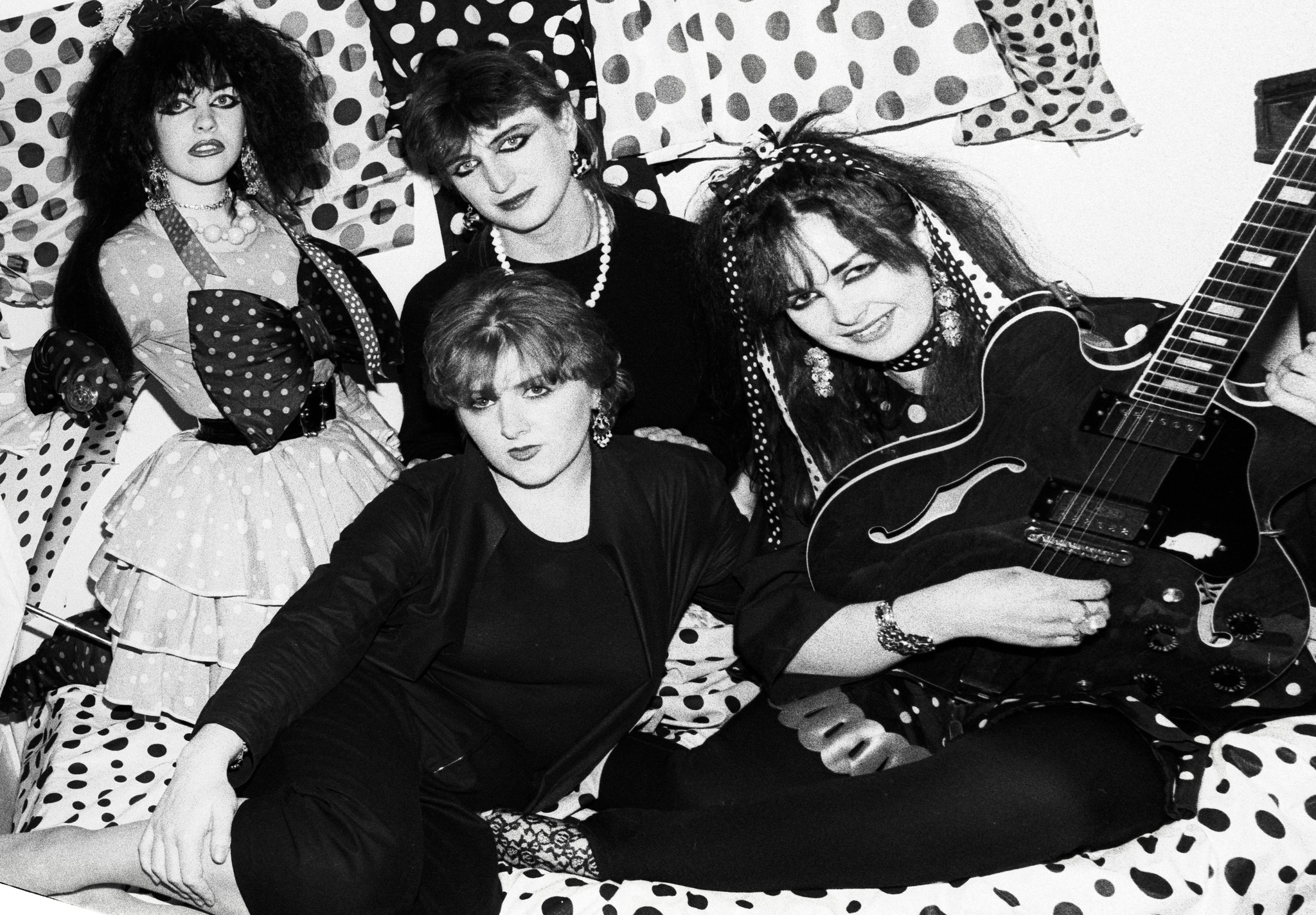
Strawberry Switchblade, four piece. Back – Rose McDowall, Janis Goodlet. Front – Carole McGowan, Jill Bryson. Taken at Jill & Peter’s flat, West End Park Street, Glasgow. Late 1981 or 1982. Pic used by kind permission of Peter Anthony McArthur, who retains copyright.
We had some similarities, Rose and I both liked Cabaret Voltaire and probably other bands. I think the difference came in the style of music we wanted to play.
Q: You single out Go Away from the demo. Another weird thing that’s happened with streaming is the album version of Go Away, the very produced one with the piano motif, has overtaken Since Yesterday on Spotify.
Since Yesterday gets a lot of listeners because it’s the one people know. It’s on all those 1980s compilations and it’s the band’s only hit. I have no idea why, but Go Away is clicking with people and that’s now the second most played Strawberry Switchblade track, behind the Trees and Flowers demo version. It’s interesting what endures, what people sift out of the repertoire.
Do you think it’s because of the lyrics in Trees and Flowers, that people are identifying with the mental health element?
Q: I think there’s a lot of that. One of the reasons why I’ve always loved Strawberry Switchblade and why I did the fansite is that the lyrics are often really dark and the contrast they bring. There are beautiful melodies with delicate harmonies, and yet these lyrics about being unsure, there’s this unease in them. That disparity that pulls you in two directions at once and you can’t quite make it fit. That’s what brings the listener back, what makes it endlessly interesting.
It’s what makes a lot of great pop music work. God Only Knows is a devoted lyric of love but it sounds like a funeral hymn. Mystery and contrast keep pulling you back because you’re trying to figure it out. With Strawberry Switchblade, song after song is like that. It’s not just Go Away and Trees and Flowers. That’s why I love the band.
The fansite is there to try to get people to stop seeing Strawberry Switchblade as squeaky pop froth and understand that there is real depth. If they weren’t Glaswegian women, then they would be seen stylistically alongside the likes of The Cure. They were from that era, doing the same kind of contrasts.
I never really thought of that at the time. Why did I not appreciate the difference between like the music and the lyrics being so wide? When I think about it now, I should have seen that. And that was what made it work. I don’t know if it was deliberate though. It was just the music we played. I think I concentrate more on the music than the lyrics which is maybe why I didn’t think about that.
You know, the funny thing is, when I listened to our demo years later I thought, actually it does have something that I didn’t really see at the time. There’s something in the music we played as a four piece that doesn’t sound like your normal pop song. There’s an undertone in the music that gives it depth somehow. There’s something there that maybe could have been brought out more.
My daughter has done music production, and she talks about how they record every instrument separately. We just played as the band and then they recorded the vocals on top!
As time went on with Strawberry Switchblade, I can remember the music and the songs were getting there. We were getting on.

Orange Juice. Back, left to right: Malcolm Ross, David McClymont, Zeke Manyika. Front: Edwyn Collins.
Rose knew the guys from Orange Juice and I knew Zeke Manyika [drummer with Orange Juice from late 1981 until their split in 1985]. I had actually recommended Zeke to them because he had played in loads of bands and I knew he was a good drummer, or maybe I had mentioned to Zeke that they were looking for a drummer.
So we knew them and they asked us if we wanted to support them at The Venue in London. I was really excited about it and I remember Rose was too.
[Note: This appears to have been 20 January 1982, Manyika’s first gig with Orange Juice, at the Venue on Victoria Street (not the namesake in New Cross which didn’t exist yet)].
So we were all going to go to London to support Orange Juice. Then Jill felt she couldn’t go, and Carole thought she couldn’t take time off from her job to go.
Rose and I ended up going down to London together to watch Orange Juice supported by the Dolly Mixtures. I was fuming that it should have been us!
In the back of my mind, I thought this might be a problem for the band later on, if people can’t make the journey or take time off work. We all try and understand each other’s problems and we knew about each other’s situations from the start, but I couldn’t really see how this was going to go further.
I went down to London again. I was going down to visit my friend anyway, but I thought, I’m going to go to the BBC studios and see if I can speak to John Peel [BBC Radio 1 DJ and legendary champion of new independent music]. I was just on my own, I went in and said, ‘can I speak to John Peel, please?’
It was weird, there were other people there, and we were all able to speak to John Peel on the phone. So the phone rang, I spoke to him and then I was about to leave and the guy said, ‘no, could you wait behind?’
The Glasgow scene was quite well known at the time, so he must have decided ‘oh I want to speak to her because it’s the Glasgow scene’. So the guy said, John Peel would like you to go up and sit in on one of his programmes.
I was talking to him about the bands and I was talking about that scene, I was talking about Strawberry Switchblade. But I think I was pushing Boys at Sea more, which was maybe wrong but we had been going for longer and probably had more songs, and I gave him a demo.
I can’t remember when it was, but it turned out that Strawberry Switchblade were playing a gig in Edinburgh with other bands and John Peel was the DJ.
I had met John Peel a week or a couple of weeks before in London, so it was kind of ‘oh, it’s you again’.
Graham came along, the guy from Boys At Sea, and we went to this Indian restaurant and John Peel was in there on his own. He said ‘oh, I’ve still got your tape, it’s on the floor in my car’. I thought, you can’t really be interested in that if it’s on the floor in your car!
Q: Don’t be so sure! I remember seeing an interview with Peel in the 1980s, he and the interviewer were driving off somewhere and he said they should get something to listen to and opened the boot of his car. It was awash in cassettes, all demos, and he just picked a few out at random.
The interviewer asked how he finds the will to keep wading through endless tapes when most of them are terrible. Peel pointed into the boot and said that the greatest music he’ll ever hear might already be in his car.
So being on the floor in his car is no bad thing. He was overflowing with tapes. I wouldn’t be offended if I was you!

Janis Goodlet playing bass in Strawberry Switchblade
A while after, when it was just Jill and Rose as Strawberry Switchblade, he must have got in touch with them and they did a session for his radio show.
Q: The session was recorded in the first week of October 1982, the Edinburgh gig was possibly in February, certainly before July, so there’s quite a gap there. Rose says Peel just rang her up, they hadn’t even given him a demo!
How many gigs do you think you did with Strawberry Switchblade? Do you feel like you were playing live much?
No, not really. We practised a lot. We were in rehearsals a lot, so I’m thinking. I would say maybe about five gigs, but I don’t know if it was more than that, I honestly don’t know.
Q: That tallies with what I’ve found, which suggests six gigs with the original quartet.
I remember Edinburgh, I remember the Venue, I’m sure there was Glasgow College of Technology, and there was the Spaghetti Factory. There must have been others.
Q: There was one at Maestro’s with the Recognitions. And there was JJ’s in Edinburgh in March 1982, not sure if there was anyone else on the bill at that.
Really? I do remember being in a van coming back from Edinburgh but that could have been the Nite Club one.
Q: There may have been more but these are the ones that we definitely know happened.
I felt I did play a lot of gigs, but Boys At Sea were playing a lot of gigs around Glasgow – I don’t think we played anywhere else – but we were playing quite a few.
Rose maybe came to see Boys At Sea, I don’t know if Jill did. I think Carole did.
In the beginning we were okay about each other being in the Poems and other bands, it was just later on that it seemed to be a thing. I don’t think the Poems had been doing anything at the time so Rose was concentrating on Strawberry Switchblade.
The 4-piece demo and leaving the band
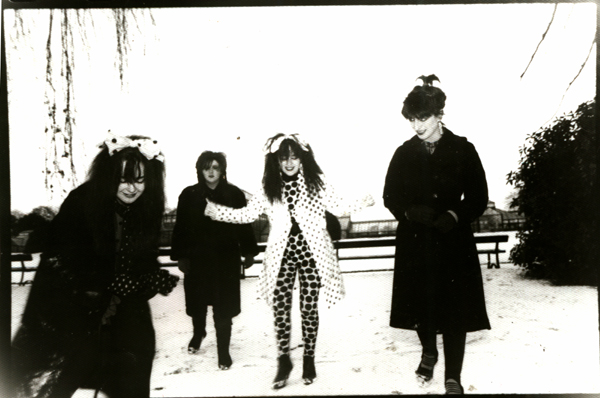
Left to right: Jill Bryson, Carole McGowan, Rose McDowall, Janis Goodlet. Jill: ‘That’s the first picture of Strawberry Switchblade. It was very cold! That’s up near the Botanic Gardens in Glasgow’. Around November 1981. Pic used by kind permission of Peter Anthony McArthur, who retains copyright.
Q: When did you hear the Strawberry Switchblade demo again? When did that come back into your life?
I think it was from Michael [Kasparis, of Night School Records who went on to release the demo].
I had contacted Jill to say that Carole had died. It was quite a few years ago now and that was really sad. Carole and I had kept in touch for a long, long time. After I left the bands I did teach for a bit, then I left that and went to work for an airline, first in London, then because they were looking for crew to be based in Amsterdam I took the opportunity. Carole came over to visit me there.
I saw her when I moved back here, but then we lost touch for a while. Then I found out from her sister she had died. So I thought Jill should be told because she was the one who’d known Carole.
A while after that, Jill contacted me to say, would you give your permission for the demo to be released? And I thought, why do they want to release that? Because it was really raw!
When I got the record I must have played it, or maybe I just heard it online.
Q: That’s possible, it was online for a long time before it was released. The fansite went online in 2003. Jill was extraordinarily generous and lent loads of her photos and cassettes, so we put all these demos and live tapes up. Michael from Night School Records heard the original demo on the fansite and recognised that there was really something to it, and he started chasing to see if there could be a proper release for it.
I thought he was a friend of Rose. When I met him, he was talking about how he played with her at some gigs. So I got the impression he’d been her friend.
Q: That came after – getting the demo EP released was why he first got in touch with Rose, then he ended up playing in her band for a few gigs and releasing some of her stuff on Night School including Cut With The Cake Knife, her demos from immediately after Strawberry Switchblade.
The demo EP finally came out in 2017 and they just pressed a thousand copies of the 7”, a nice little indie release. But in 2017 streaming services were happening, so it went on there too.
For reasons that nobody seems to understand, in late 2024 it suddenly took off as music that people used on their videos on TikTok. There were people using it because they like the music and they’re talking about it. There were other people using it because it’s called Trees and Flowers, and they’re doing a little video about gardening or something.
What do you think of the demo then? Do you think it worked as a four piece?
Q: It’s a very honest recording, and quite a different band to the later duo. It’s direct, it’s made with absolute clarity and integrity. There are no ulterior motives, it’s people writing and playing for the love of it and because they’re conscious of wanting to really convey something that they’re still figuring out.
It does sound like people who haven’t been playing long, teenagers discovering writing and playing together. That’s a big part of why Trees and Flowers connects with people, it was the first song Jill wrote and it’s got that directness of ‘I’m just going to say it’.
I think that’s why the demo’s really taken off now because so much of what we hear now is so polished, calculated and artificial, so the genuine performance of the demo, the authenticity of it really hits home. It’s now far and away the most streamed Strawberry Switchblade track, pretty much equalling everything else combined. It’s really embedded itself in culture.
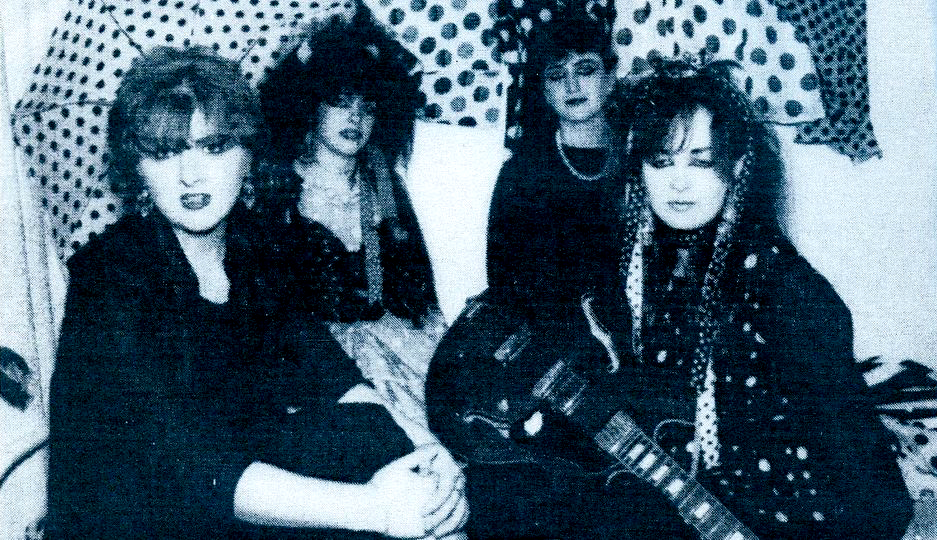
Strawberry Switchblade. Left to right: Carole McGowan, Rose McDowall, Janis Goodlet, Jill Bryson. Pic used by kind permission of Peter Anthony McArthur, who retains copyright.
I went to see a film, The Chronology of Water, directed by Kristen Stewart. Michael had contacted to say they wanted to use Trees and Flowers in the film. The film is very explicit, about trauma. I found it really upsetting, they don’t hold back. But the song comes on at quite a nice part in the film.
Q: It’s a heartfelt song that accepts mental health struggles as ordinary fact of life. In 1981, that was pretty radical. But for Gen Z and Gen Alpha, this is how they live. No wonder it totally clicks with them. But it also sounds old and authentic, it doesn’t sound contrived and marketed. So there’s a whole new generation that have found the band due to that version of Trees and Flowers.
I would just have thought people would have listened to the album version!
Q: The other two songs on the EP are both in the top ten most streamed Strawberry Switchblade tracks too. Trees and Flowers brings people in and they’re listening to the other two because of that.
As early as 2020 someone released a cover of the demo version of Go Away. Did you also know there are four different YouTube videos by bassists doing covers showing how to play your bassline for Trees and Flowers?
And Go Away! I’ve heard them. That did make me think, ‘in your face, guy at the BBC who said I couldn’t play’! Lol.
Q: How did you end up leaving Strawberry Switchblade?
I was still in Boys At Sea, and I really liked the way we were going. I remember we did this interview – and I remember Carole bringing this up – she asked, if you had to choose just one of the bands to be in, who would you choose? Strawberry Switchblade or Boys At Sea?
I hadn’t thought of it in those terms, I wasn’t the only one who was in another band in the beginning, Rose was in The Poems although I don’t think they were doing anything at the time whereas Boys at Sea were. But I realised that this also might be a problem, me being in two bands.
At the end, I remember a meeting with all four of us. I don’t know whose flat it was. We went up and things were getting a bit……, I felt that we weren’t getting on so well. It felt that things were different. Rose had brought in a girl who I didn’t know to be our manager, although I don’t know if Jill knew her either, but Carole didn’t. I didn’t feel we needed a manager at that time and didn’t see what she could do that we couldn’t do ourselves at that stage. That wasn’t long before I left. It wasn’t that though. I just felt things were changing between us.
I think it was brought up again that I was in two bands as well. I just thought, right, maybe I should just leave. And I left. I hadn’t planned it but it felt like the right thing and I’d maybe had it in the back of my mind for a while.
It had come to the point where it wasn’t going to work being in two bands and I felt I could do more in Boys at Sea. I wasn’t working at the time so it was nothing to do with a job although I’ve seen that that was the reason given in an interview for me leaving.
Q: So did you and Carole leave at the same time?

Boys At Sea live review by Tommy Udo, believed to be in Sounds, 1982. He discreetly fails to mention that he was recently in the band!
No, that was a weird thing. I just left. It was coming to a point that I did have to choose. So I chose Boys At Sea. I went to the nearest pub, I knew Graham and the rest of our friends would be there. About half an hour later Carole came in and said, I’ve left as well. That really surprised me.
I’ve spoken to her son about it, actually. He said ‘she left because you did,’ which I didn’t know. I don’t know what happened when I left, to make Carole leave as well. I think Carole wasn’t getting on that well with Rose. They weren’t really close. I don’t remember Carole and I talking about it that much, she obviously had her reasons.
Carole and I kept in touch afterwards. We became really good friends.
When we were together at the beginning, making music and getting to know each other, it was really good. It was nice that we all worked together and just kind of gelled. I don’t want to come across negative because it really wasn’t!
Q: How did Boys At Sea go after that?
Well [laughs]. We went on for a while after that. We changed line up a bit. Tommy Udo had been the bass player in the beginning but he was doing more with journalism for Sounds. So we got another guy John and he was really good. We had changed drummers a couple of times.
And yeah, Graham and I weren’t getting on. I can’t remember exactly, I think there was something about we’d had an argument. I went along to rehearsal, but he didn’t. I just thought, again, this isn’t going right. We were all supposed to be playing music together, being friends, and it was all getting a bit oh [groans]. So I decided to leave.
Then Boys At Sea just kind of fell apart. I’m not saying it’s because I left, but they didn’t get another singer or anything. So that didn’t work out either.
For a long time after that, I couldn’t listen to music. It was weird, I just thought I don’t really want anything to do with it, I just couldn’t listen to music. That came back, obviously. But I was never in another band.
Q: When did you leave Boys At Sea? How long after Strawberry Switchblade?
Less than a year later. Not sure. It’s hard to remember timelines going back forty years.
Q: There’s so much curiosity about this incarnation of the Strawberry Switchblade and these three tracks. It’s going to be a real gem to have this interview with you on the site.
Oh that’s really nice. I suppose at the back of my mind, I feel that when Strawberry Switchblade became a two piece it was their thing. People still know them as a two piece.
Q: There’s a whole new load of people who are hearing the demo first and then get surprised that there’s this ribbons and Top of the Pops side of it that they didn’t suspect was going to be there.
I kind of took a back seat because I thought the people who know Strawberry Switchblade think of them as a two piece. So when people say to me, were you in Strawberry Switchblade? I kind of think, well yes, I was, but not as you know them when they got well known after I left.
Q: Kind of a Pete Best role!
Yes the kind of thing where he was in a band before they were well known, although wasn’t he sacked? So it’s a bit different. I know that we were there from the very beginning and contributed a lot. It was the four of us, so I’m glad the demo was released as an EP and people seemed to take to it and got to know us as a band.
The most important thing I wanted to get across, that I felt was never mentioned in interviews about us, and this is personal to me, was that the reason I left Strawberry Switchblade was for another band. And that’s no reflection on them, it’s just that I felt I was more invested in the other band.
I felt I could do more in another band. And that’s nothing like derogatory about Strawberry Switchblade, it’s just how I felt at the time.
I still thought we’d all still be friends, but it didn’t really work out like that.
For a long time afterwards I didn’t really think about it, and I didn’t regret it or anything like that. It was a surprise when Jill contacted me to say about the demo and it was great to hear it again.
It’s good that people now see that we were a four piece and that girls could work together, because I’d never really had that before. Playing the piano from such a young age, it’s a very solo instrument. I’d never played in an orchestra, I’d never really played with people. So it meant a lot to me to play, especially with girls who were all just learning. That was the best thing.
Commercial considerations and meeting up again
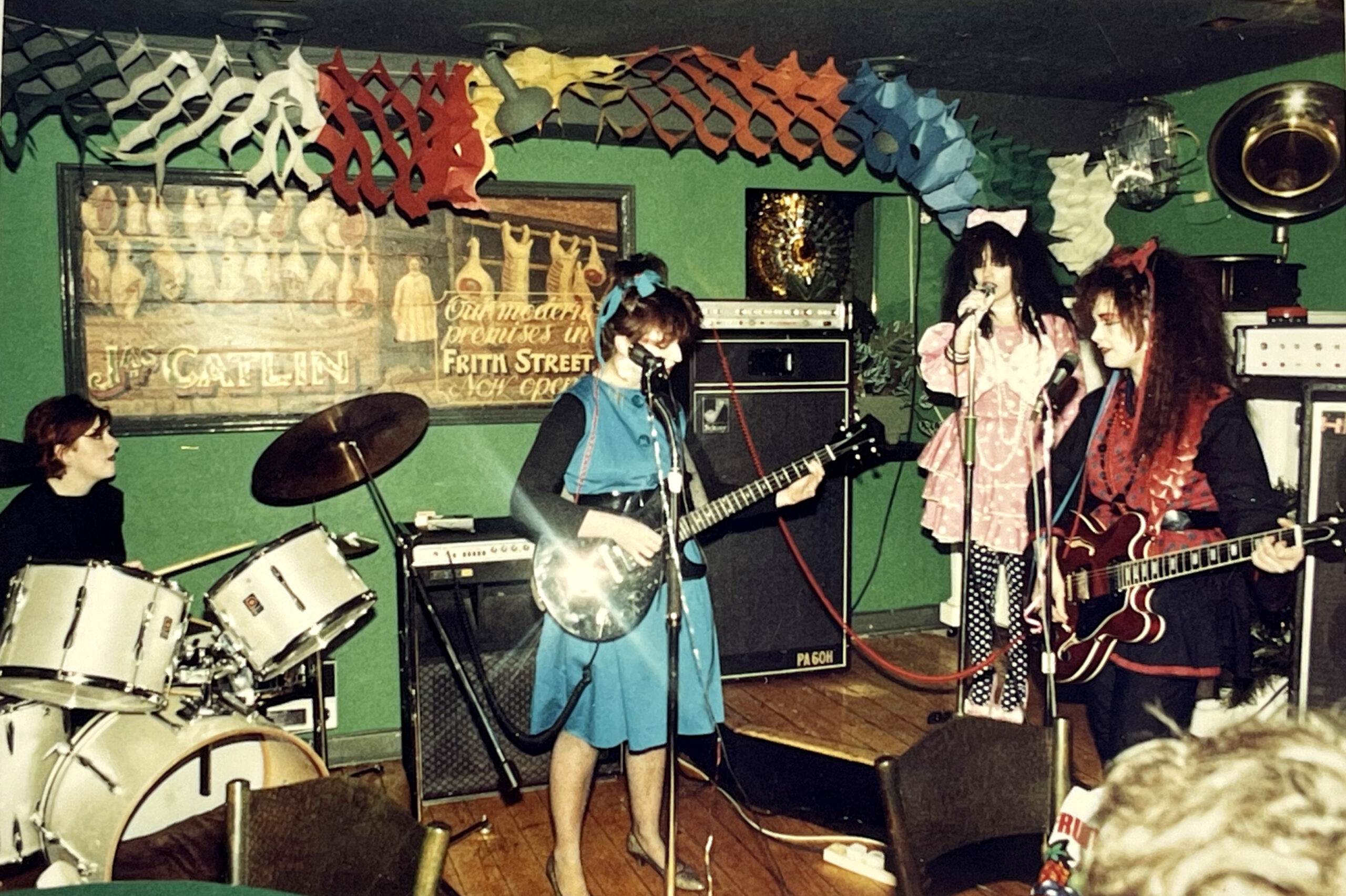
The only known photo of all four members of Strawberry Switchblade on stage together. Taken at their first gig, Spaghetti Factory, Glasgow, December 1981. Carole McGowan (drums), Janis Goodlet (bass), Rose McDowall (vocals), Jill Bryson (guitar). Pic used by kind permission of Peter Anthony McArthur, who retains copyright.
And then when I heard the Strawberry Switchblade album I thought, why is it electronic?
I hope you don’t mind me asking this, it’s you that’s meant to be asking the questions, but why didn’t they really like it when they got musicians in later on? Why didn’t they like the sound that was produced, and then ditch it for the electronics?
Q: No one’s really clear whose decision it was or precisely what was wrong. We’ve got three live recordings and the two studio tracks by that five-piece line-up on the fansite.
Was it James Kirk [of Orange Juice] that played?
Q: No, he played on the 1982 BBC sessions, but the gigging band was later, the end of 1983 and into early 1984.
Simon Booth – he was Simon Emmerson but he went by the name Simon Booth at the time – was out of Weekend and Working Week, and a very accomplished guitarist, hence having him in the band. He was sort of musical director at the time, with John Cook on bass and Roy Dodds on drums.
They had a really good indie guitar sound, Emmerson had got great Johnny Marr-type twiddles on him. You can easily imagine that sound being next to the Mighty Lemon Drops or something on John Peel.
They were a live band and they started recording the album that way. They had Robin Millar producing who had just done debut albums for Sade and Everything But The Girl. They got two songs into making the album – and it’s not clear who’s taken the decision or was pushing for it – but the sound was felt to be unsatisfactory. So they started casting around for other producers.
David Motion and his electronica came up. Talking to other people around it at the time, I think Rose and Jill were into it a bit more than they might say they were now. I don’t think they were being forced to do anything they really hated. Jill’s certainly quite clear about the fact that they liked it at the time were into it. And there are a lot of dark textures on the album. There is a good deal of mystery and melancholy there woven into the shiny pop.
My daughter saw them on a repeat of an old Top of the Pops and pointed out that Jill had a guitar with her but she wasn’t playing it. That is like the record company have just manipulated the whole sound, maybe.
Q: They had a conundrum because Since Yesterday doesn’t have any audible guitars on it. But if you’re Jill and you’re just doing harmony vocals, what are you going to do the rest of the time on telly? Also, it was written on guitar, so she’s playing it how she wrote it.
I remember I heard an interview on Radio Scotland with Jill and they asked her, what did you think the next single should be? And she said Deep Water.
I thought that’s a brilliant song. It’s a lot heavier, and there’s just more to it than some of the other ones. It’s very atmospheric. But I remember her saying, the record company probably wouldn’t go for that.
I think the record company had an idea of what they should be. I read or heard somewhere that Rose has even said, maybe we should have pushed back more but the record company always said just try it, just try it and we’ll see how it goes. I’ve come across that before in different situations and I think that’s the way to get people to do what you want!
Q: Definitely. As well as that, perhaps they were easier to push around because they weren’t a full band any more. When you’ve got two people who sing and play guitar, where’s the rest of the noise coming from? It’s all too easy to get a producer who’s going to put in all the production and really fill song out, whereas if it was a band with bass and drums, it’d already be clear who would be playing, and the band would have held more sway.
I always thought, though, if Carole and I had stayed, and looking at it now, I think we might have been ousted out by the record company, especially if they wanted an electronic sound and we hadn’t been given enough time to develop our instruments. I mean, I think Rose and Jill are beautiful. So, I don’t know if they would have pushed the image, you know how sometimes record companies do that?
Q: Did you see what WEA did with Fuzzbox? The same label – probably the same individual staff – dealing with another original all-female band just a couple of years later. Do you remember them?
No.
Q: Their full name was We’ve Got a Fuzzbox and We’re Gonna Use It. Four young women from Birmingham in about 1986. They had this great dirty fuzzy guitar, hence the name, and songs they wrote themselves. It had punky verve and a lot of the same outsider energy as the Strawberry Switchblade demo.
Then they got signed to WEA, a really major label, and polished up. One of them got singled out and pushed to the front, and it was all so marketed at the mainstream. It’s almost like the record company listened to XX Sex and tried to turn them into what they were railing against.
As with Strawberry Switchblade, they were miming with their guitars for tracks where you can only really hear electronics. They even hired the fella who wrote Walk Like an Egyptian to come and co-write with them. The corporate pressure on women artists was monstrous.
They weren’t really taken as seriously as they should have been because they’re women, because of misogyny. It certainly happened to Rose and Jill, they just weren’t taken seriously in the way that male bands were.
It’s not just down to being a duo either, there were loads of male duos at the time without a full band – Tears for Fears, The Communards, Pet Shop Boys, Hue & Cry, et cetera – who were seen as credible songwriters and musicians. But Rose and Jill were women in makeup with startling dresses and so their creative abilities were sidelined.
I also felt that maybe we would have been pushed out because, at the end of the day, we couldn’t really play our instruments very well! We would have got better the more it had gone on, I’m sure. Some bands get time to develop their sound and instruments, some bands don’t and we hadn’t been going for all that long.
I remember seeing the Belle Stars in Glasgow and thinking, I love them. I didn’t really like some of the songs that much, but I loved that they could play their instruments really well. I thought they would wipe the floor with us because they can really play, technically.

Janis Goodlet on stage with Boys At Sea
Q: They were much more experienced though. The Belle Stars developed from the Bodysnatchers, and if you listen to the Bodysnatchers’ two singles, they kind of sound like the Strawberry Switchblade demo. They’ve got the energy of a band who are fresh to it, and that’s why it’s interesting. Then after a couple of years they’ve developed the chops, they bloom and we’ve got the Belle Stars.
So, given a bit of time, who knows where the four-piece Strawberry Switchblade would have ended up. It’s hard to imagine WEA wanting the four-piece line-up, but maybe an indie label would have. If Postcard had still been going in Glasgow at the time it would surely have been a natural home.
What was the one that The Fall were on?
Q: Step Forward?
I can’t remember the name, but I know some maybe something like that. Although I think most of their acts were a bit heavier. But yeah, I think we would have got better.
I mean, I really did wish them well, and I think it is a shame that it just didn’t really work out. The songs they were writing like Deep Water were really good.
It’s sad that they ended up not speaking for a while after as well. How did it end up like that?
Q: They’re very different people, Rose and Jill. They were put through this really pressurised experience for two or three years there. They didn’t know anything about the business side of things, and so they came out with horrible contractual issues and loads of debt, which is the kind of thing that turns people against each other.
Relations have come and gone between them, and it’s why it was really meaningful seeing them on a panel together for the Glasgow premiere of the Since Yesterday film at the Centre for Contemporary Arts in August 2024.
A couple of months later they were together again on the panel at the Q&A after a showing of the film at Glasgow Film Theatre in October 2024. For those of us who love the band, seeing them get on with each other and making each other laugh was lovely.
I’d met David Henderson, who ran the Hellfire Club [early 1980s Glasgow rehearsal room and recording studio where the Strawberry Switchblade demo was recorded]. I met him at the Future Islands gig and he talked about the film that was being made.
Carole’s brother had also told me that Carla Easton had been in touch with him to say they were making a film about girl bands and would he like to go to the film showing.
She’d sent him pictures of who she apparently thought was Carole but they were actually of me, so he sent me the pictures and he had to put her right. She hadn’t got in touch with me, maybe she didn’t know how to, so I ended up somehow getting in touch with her and said I can help.
She said they had been just going to concentrate on Strawberry Switchblade as a two piece, although all the other bands featured seemed to tell their story from the beginning and I wasn’t interviewed, so I did find that a bit odd, but they did bring in the original four-piece – I mean, we’re kind of blink and you miss it! – there’s a bit of us playing the Venue and how we got together is mentioned. So I ended up going to the first GFT showing.

Rose McDowall (front row, second from left) and Jill Bryson (back row, centre) with some of the cast and crew of ‘Since Yesterday: The Untold Story of Scotland’s Girl Bands‘ preview screening at CCA, Glasgow, 10 August 2024. Pic: Shaun Murawski.
There was a party afterwards in the record shop that Michael Kasparis works in. I had already met Rose at the screening earlier in the day. I didn’t recognise her at first, but then I realised it was her and we started talking and the years just fell away. It was like we were still really good friends, which I didn’t really expect, but we actually know each other quite well.
Then at the party in the record shop I saw Jill up the other end. So I went up to speak to her, and again it was like the years had fallen away.
Q: The interaction between them on the panel at the GFT the next night was fantastic.
That’s good. We’re all older now and a lot of time has passed.
I was going to meet Jill just after Carole died but it didn’t happen. So the first time I had seen Rose or Jill was at that party in the record shop. It would have been nice to have a chance to talk to them more one-on-one without the party thing going on. But yeah, it’s just the way it was. We planned to keep in touch and Rose and I messaged a few times afterwards but we all have our own lives now.
What was really nice, and I was actually quite surprised, was when I met Rose and Jill at the screening party, they were so happy. We were all so happy to see each other.
I remember I was talking to Rose about general things, catching up on what we had been doing for forty years, different things. She said to me, oh you’re one of the strongest people I know. And I think, no I’m not, but it was nice for her to say it.
I thought, now I remember just how how close we really were. That was really nice, to let all the years fall away.